Most people see the numbers.
Few see the systems that make those numbers possible.
And when those systems work well, almost no one notices them.
At The Digital Ledger, we focus on automation, technology, and the future of finance. But it’s equally important to highlight the people who design the processes, improve systems, and optimize operations—the finance leaders who quietly drive results.
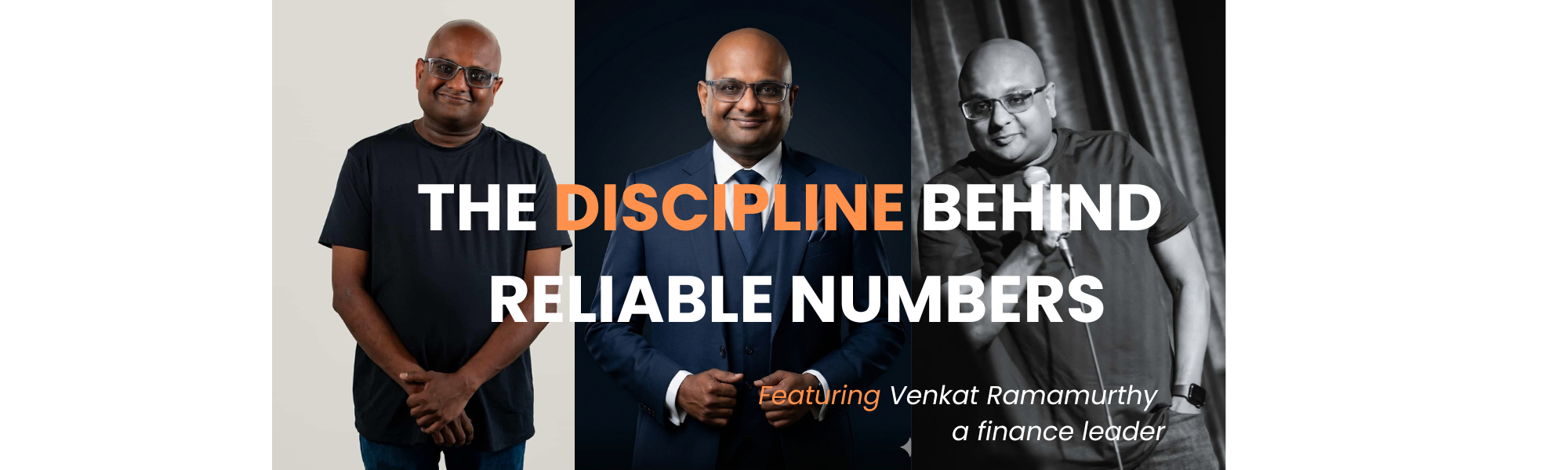
Our latest conversation features Venkat Ramamurthy, whose two-decade career spans aviation, healthcare, enterprise distribution, and technology.
Today, he’s a Compliance Auditor at Novitas Solutions, reviewing Medicare and Medicaid claims for accuracy and regulatory compliance. His career shows a broader truth: reliable finance isn’t just about numbers—it’s about the systems behind them.
Learning the Work From the Inside
Venkat’s finance journey began early. His father was an internal auditor in Bahrain, and so were his uncles. The profession was always around him. After a bachelor’s in accounting and auditing in Mumbai, he moved to the U.S. for an MBA in finance.
Early roles in smaller organizations gave him hands-on experience.
“I started at the grassroots level,” Venkat said. “Running payroll, issuing checks, making sure the taxes and deductions were right.”
That foundation showed him how financial work actually flows through a company.
“Finance teams don’t just record results. They design the processes that produce them.”
This mindset would guide his entire career.
Brought In to Change the System
One of the biggest moves in Venkat’s career came when Sysco hired him as a part of their team for their ERP migration. The company was moving from a legacy DOS-based accounting system to SAP and standardizing processes across multiple operating units.
ERP transitions are rarely solved by technology alone. People and processes matter more.
“Transitions are always chaotic. People are used to the old way, and habits are hard to break. The real challenge isn’t the software—it’s communication,” Venkat said.
For years, he worked with teams to align reconciliations, build templates, and produce consistent financial data before the system went live.
“Systems only work if the process behind them works.”
Cutting Deadlines Down
Finance operates on a clock. Month-end deadlines expose inefficiencies fast.
“The mindset that drives cost reduction and margin improvement is deadlines,” Venkat said.
At one point, a tedious reconciliation process for employee credit cards required multiple accountants manually extracting and reconciling data.
Venkat and a colleague wrote a script that automated the workflow, feeding data directly into Excel.
“A process that used to involve ten accountants suddenly didn’t need them anymore.”
These small changes add up, freeing teams to focus on analysis instead of mechanical work.
Clarity is Everything
One idea runs through all of Venkat’s work: clarity.
“Operational clarity is essential in finance. People need clear steps to follow, or you have complete chaos.”
He has spent much of his career documenting procedures, building templates, and designing workflows that help teams execute tasks consistently.
It’s not glamorous, but it separates organizations that scale smoothly from those that rely on tribal knowledge.
A New Generation of Talent
Venkat has seen the next generation approach finance differently.
“They have zero tolerance for work they see as boring. They gravitate toward analytical tasks. Leaders must adapt.”
Today’s finance professionals expect automation to handle routine work. For leaders, this means inviting curiosity, answering questions, and helping teams focus on insights rather than repetitive tasks.
“The next generation will ask why. Great leaders need to be ready to answer.”
Comedy and Communication
Outside finance, Venkat has an unusual skill: stand-up comedy. Over the past few years, he has performed at The Dallas Comedy Club.
The path to comedy began after the loss of his father. It started as a personal outlet and gradually became something he enjoys deeply.
“Comedy helped me communicate better. On stage, the audience feeds off your energy. The same principle applies in business. You can’t control the reaction, but you can control the energy and confidence you bring to a message.”
The lesson translates perfectly into leadership: numbers alone aren’t enough. How they’re communicated determines whether anyone acts on them.
The People Behind the Numbers
Finance careers are often measured by titles.
Controller. Director. CFO.
But conversations like this reveal another side of the profession. Behind smoother close cycles, stronger controls, and reliable reporting are professionals steadily improving the systems that produce the numbers.
Venkat Ramamurthy is one of them.
Reliable numbers don’t come from software alone—they come from people who build processes that work, reduce friction, and make operations clearer.
And sometimes, after the spreadsheets are closed, they step onto a stage in Dallas and try to make a room full of strangers laugh. Which, depending on the audience, might actually be the harder job.
If you want to follow Venkat’s comedic career, check out the Dallas Comedy Club, and see one of his skits here: https://www.facebook.com/reel/1023294679972629
Behind every performance is a system.
Stay ahead in finance.
Click “Join free” on your left.
This is where you learn how the best actually operate.