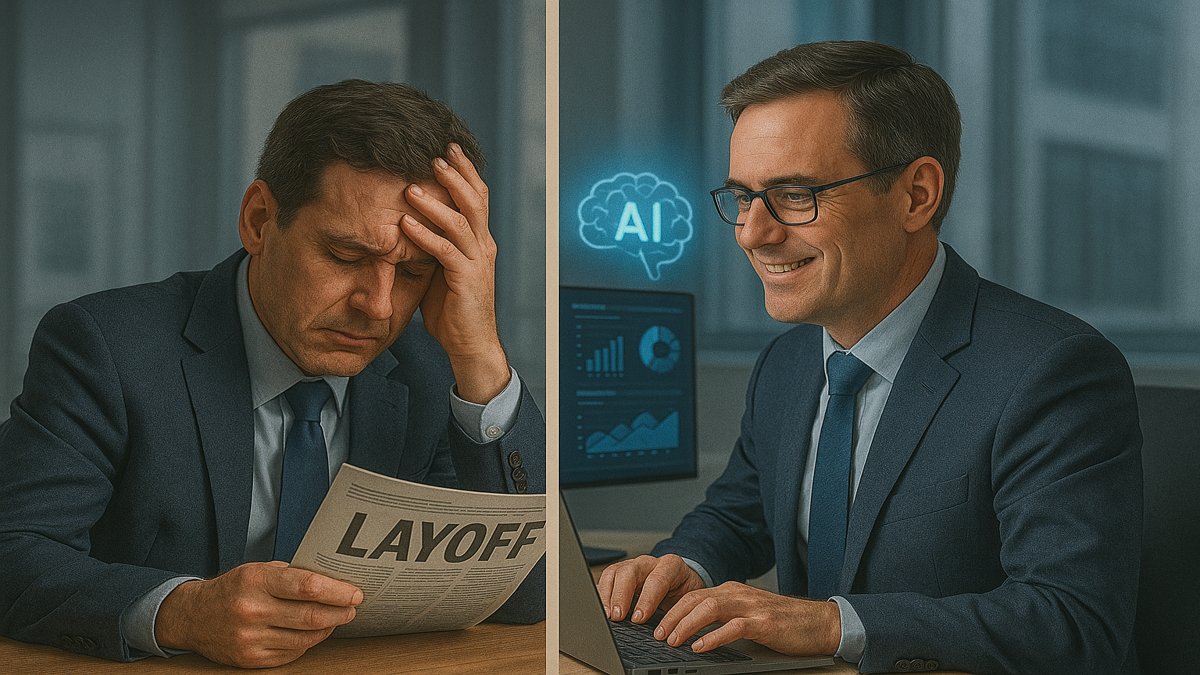
1. Takeaway #1: The Threat is Real—AI Is Officially a Major Driver of Layoffs
The scale of recent job cuts is significant. The "Challenger Report" notes that October 2025 saw the highest number of layoffs for that month since 2003, with 153,074 announced cuts. While Cost-Cutting was the top reason cited by employers, Artificial Intelligence was the clear second, responsible for 31,039 job cuts in October alone.
The report draws a powerful parallel between the current disruption and the technological upheaval of 2003, a period marked by the widespread adoption of cell phones. As Andy Challenger, workplace expert and chief revenue officer for Challenger, Gray & Christmas, noted:
“Like in 2003, a disruptive technology is changing the landscape.”
This data confirms the fear many professionals hold: companies are actively using AI adoption as a rationale for restructuring and reducing their workforce.
2. Takeaway #2: AI Isn't Just Replacing Accountants—It's Making Them Massively More Productive
While the broader market sheds over 31,000 jobs to AI in a single month, new research reveals that accountants actively using the technology are seeing productivity gains of up to 59%. In direct contrast to the broad-market layoff data, a new paper titled "Human + AI in Accounting" reveals a dramatically different reality for accounting professionals who are actively using GenAI tools. The study found that adoption is associated with significant productivity gains.
According to the field data, a one standard deviation increase in AI use was associated with an 18% increase in weekly client support. The effect was even more pronounced at the extremes: when comparing accountants with the highest and lowest AI usage, the estimated productivity gain was as high as 59%. This finding presents a crucial counterpoint to the replacement narrative. While the broader market sees job losses, accountants actively using AI are becoming more efficient and capable, not obsolete.
3. Takeaway #3: Your Daily Grind Is Changing: Less Routine Data Entry, More High-Value Work
The productivity boost from AI isn't just about working faster; it's about working differently. The "Human + AI in Accounting" paper shows that AI adoption triggers a fundamental shift in how accountants allocate their time. The data reveals that a one standard deviation increase in GenAI usage was associated with a 2.6 percentage point reduction in time spent on routine data entry. For a standard 40-hour workweek, that translates to reclaiming approximately one hour.
That recovered time is being reinvested into higher-value work. Accountants are spending more time on critical tasks like business communication, quality assurance, and even advisory services and professional training. This is further supported by survey data from the paper, which found that GenAI users reported logging 23% more billable hours with no significant change in non-billable hours. This suggests a clear shift away from administrative overhead and toward more valuable, client-facing activities.
4. Takeaway #4: Surprise—AI Can Actually Improve Financial Reporting Quality
A common fear surrounding AI in finance is that speed will come at the cost of accuracy. Survey data from the "Human + AI in Accounting" paper confirms this anxiety, with 62% of accountants expressing concern about errors and the quality of financial reporting that relies on GenAI.
However, the field data from the same study offers a direct rebuttal to this concern. GenAI adoption was associated with two key improvements in financial reporting quality:
• A 12% increase in ledger granularity, measured by the number of unique general ledger accounts used. More detailed account structures facilitate efficient budgeting, more accurate cost tracking, and greater flexibility in generating tailored financial statements for investors and lenders.
• A 7.5-day reduction in the time needed to close the books at month-end.
These gains were most pronounced in financially complex, later-stage small and medium-sized enterprises (SMEs), where timely and detailed records are most critical. This evidence is critical, as it suggests that the belt-tightening and restructuring cited in the Challenger Report may not be a simple story of replacing humans with cheaper tech, but a more strategic move toward higher-quality, faster financial intelligence that AI-augmented teams can provide.
5. Takeaway #5: In the Age of AI, Your Professional Experience Matters More, Not Less
Perhaps the most critical takeaway is that AI does not devalue human expertise—it amplifies it. The "Human + AI in Accounting" paper highlights a clear pattern of AI-human complementarity. The AI platform studied provides "confidence scores" with its recommendations, signaling how certain it is about a given classification. This feature transforms the AI from a "black box" into a collaborative partner, providing the signals an expert needs to apply their judgment effectively.
The study found that more experienced accountants intervene more strategically. They were more likely to override the AI's suggestions precisely when its confidence scores were low, applying their professional judgment where it was needed most. In contrast, less experienced accountants were less responsive to these signals of uncertainty. This demonstrates that expertise is critical for providing effective oversight and extracting the most value from AI tools. This finding carries a clear message for firm leaders: the ROI on AI tools is directly tied to the expertise of the professionals wielding them. AI is not a substitute for experience; it is a multiplier of it.
As the paper's authors conclude, the findings point toward a future of collaboration, not replacement.
"...our findings highlight AI’s role in potentially augmenting, rather than replacing, professional accounting expertise."
--------------------------------------------------------------------------------
Conclusion: From Threat to Tool
The data presents a clear duality. In the broader economy, AI is a genuine disruptive force contributing to significant job displacement. Yet for accounting professionals, it is emerging as a powerful augmentation tool that boosts productivity, enhances reporting quality, and elevates the importance of human judgment.
The challenge for the profession is not one of survival, but of adaptation. Adaptation will mean a conscious shift in skill development, prioritizing strategic analysis, client advisory, and the critical judgment needed to oversee—and override—AI recommendations. The firms and professionals who master this human-AI collaboration will not just survive; they will define the future of the profession. The question for finance and accounting professionals is no longer if AI will change their work, but how they will leverage it to redefine their value in a rapidly evolving landscape.
Sources
• "Challenger Report, October 2025." Challenger, Gray & Christmas. November 2025.
• Choi, J. H., & Xie, C. L. (2025). "Human + AI in Accounting: Early Evidence from the Field." SSRN. September 2025.