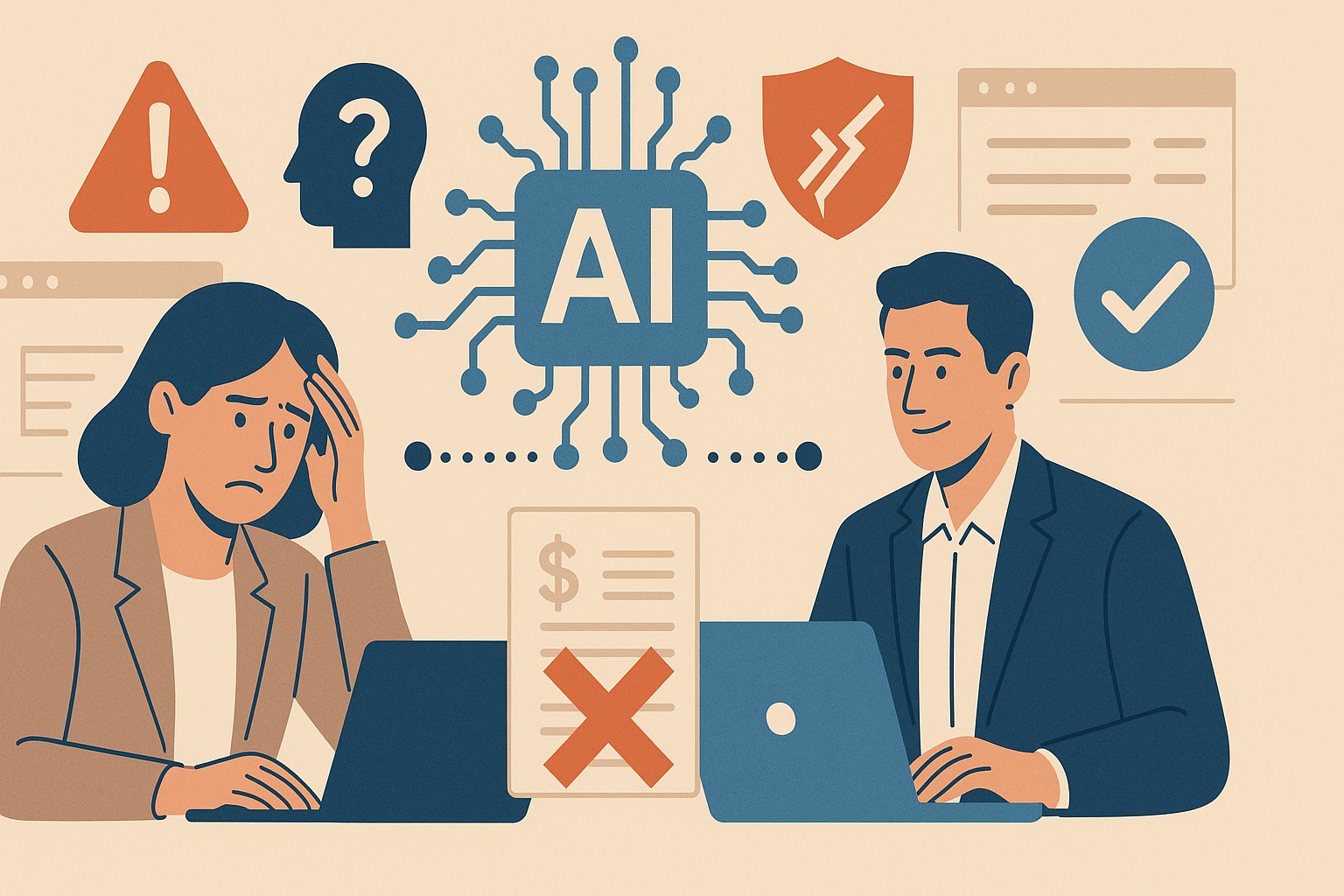
1. The Threat Feels Personal: AI-Powered Fraud
Finance teams aren’t just skeptical about AI—they’re often directly targeted by it. Their fear isn’t of the unknown, but of real attacks they’ve already seen. AI has powered a new wave of fraud that feels very personal to those responsible for keeping the books clean and the company safe.
Billtrust’s research shows how severe this threat has become:
Nearly half of finance staff received AI-generated phishing emails that even fooled senior leaders.
About 4 in 10 got fake emails that perfectly imitated executives or vendors.
31% saw fake invoices using real logos and formats.
29% encountered AI-created voice messages impersonating known contacts.
For finance professionals, these aren’t just numbers—they represent daily battles against scams that threaten trust, accuracy, and accountability. Compared to other departments using AI to save time or boost creativity, finance teams are on the defensive, facing AI as both a risk and a weapon.
2. The Confidence Crisis: Believing in AI but Not Trusting It
Insight Software’s study reveals a key issue: while 58% of finance professionals believe AI can improve their work, only 39% actually trust themselves to use it effectively.
This 19-point gap exists for two main reasons—concerns about data security and a lack of AI training and resources. In other words, even when teams believe in AI’s potential, they don’t feel equipped or protected enough to adopt it confidently.
Billtrust’s research adds another layer of concern. Although 76% of finance professionals believe their teams would catch fake invoices, almost half worry that AI’s growing sophistication will eventually outsmart them.
Put simply, manual, periodic reviews can’t keep up with full-time, automated fraud attempts. Trusting old systems to catch next-generation threats leaves teams vulnerable to failure.
3. The Smart Fix: Using AI to Fight AI
The answer isn’t avoiding AI—it’s using it wisely. The best strategy is to let AI do what it’s best at while keeping human judgment in control.
Billtrust recommends a “human-in-the-loop” model. Here’s how it works:
AI scans and processes massive amounts of data quickly.
It flags suspicious activity or potential errors with supporting details.
Humans make the final decision, ensuring that oversight and accountability stay intact.
This blend of automation and human review allows AI to strengthen, not weaken, the finance team’s control. Instead of replacing people, AI becomes an assistant—one that helps professionals do their jobs faster, more accurately, and with greater confidence.
Conclusion: The Inevitable Wave of AI and the Need for Leadership
AI in finance isn’t a future scenario—it’s already happening. According to Billtrust, 70% of finance leaders expect more AI in their teams within the next year, and over a quarter predict a major surge.
To prepare, leadership must focus on three key principles:
Build secure AI systems that protect company data.
Keep AI processes transparent and accountable.
Ensure people stay at the center of decision-making.
Training, open communication, and careful implementation can turn AI from a source of fear into a tool of empowerment.
The real question isn’t whether your department will adopt AI—but how your team will harness it confidently while staying one step ahead of its risks.
Sources: