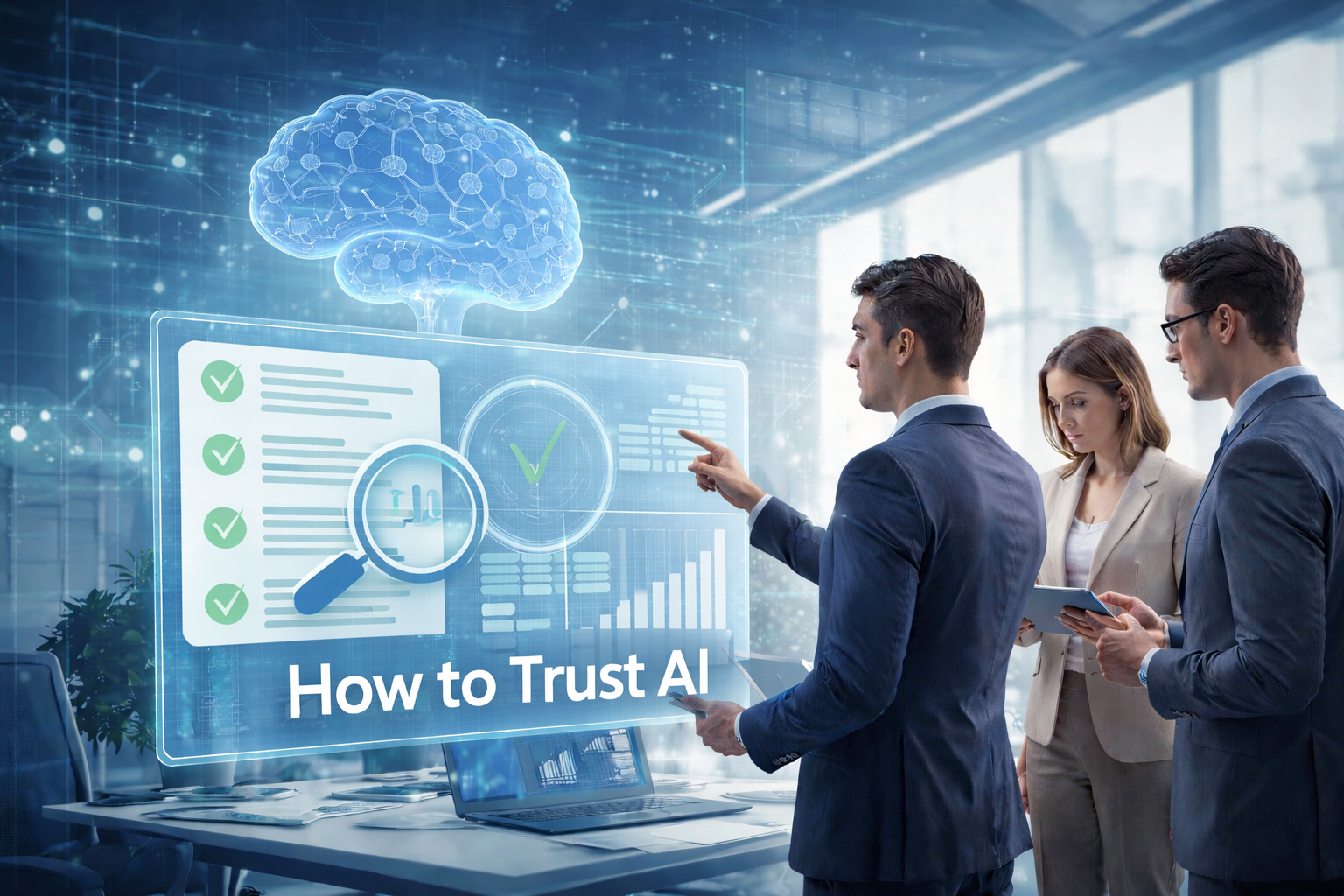
1. The New Golden Rule: “Verify, Then Trust”
“Trust but verify” made sense when processes were predictable and run by humans. In the AI era, this approach no longer works.
The new rule, verify, then trust, is a required way of managing risk when using AI systems. This is not just a wording change. It is a major update to internal controls for systems that do not always behave the same way.
For finance professionals, accuracy and accountability are essential. Before trusting AI outputs in important workflows, teams must first verify where the data comes from, how reliable the system is, and whether it follows required rules. Trust should come only after evidence, not assumptions. This creates confidence that is built on proof.
2. Surprise: Trust Isn’t an Algorithm, It’s a User Experience
It is easy to think that trust in AI is a technical problem that better models or more data can fix. In reality, trust is mostly a user experience and emotional issue.
The goal is not maximum trust. It is calibrated trust. That means finding the right balance between being too skeptical and relying on AI too much.
Many AI systems act like “black boxes.” They give answers without clearly explaining how they reached them. This makes users feel like they are losing control. That feeling leads to doubt, lowers confidence, and stops adoption.
The real goal is to match trust to what the AI can actually do, based on verification. Users should not blindly accept results, but they also should not ignore them without reason.
“Trust isn’t a technical metric you can optimize with better algorithms. It’s a user experience challenge. As AI integrates into everyday products, trust becomes ‘the invisible user interface’. When this interface works, interactions feel seamless and powerful. When it breaks, the entire experience collapses.”
3. Redefine “Accuracy” for the AI Era: It’s a Risk Framework, Not a Number
In enterprise finance, accuracy is not just a percentage score. It is a risk framework. The question is not whether an answer sounds right, but whether it is safe and reliable for critical business decisions.
This framework includes six key parts:
• Fidelity to the source: All facts, numbers, conditions, and references from the original data must be preserved.
• Factual correctness: The system must avoid making up false but believable information, known as hallucinations.
• Consistency and determinism: Similar inputs should lead to stable, repeatable outputs.
• Terminology and style: Outputs must follow approved brand language, legal wording, and financial terms.
• Risk-adjusted accuracy: Even small mistakes can have large legal, financial, or reputational consequences.
• Governance and auditability: Teams must be able to track what was generated, when it was generated, and under which controls.
For enterprise finance, fluent writing is expected. The real challenge is making sure outputs are dependable, verifiable, and safe. Anything less creates unacceptable risk.
4. Your Biggest Threat Isn’t a Mistake, It’s a Confident Lie (Also Known as a Hallucination)
AI hallucinations are not simple errors. They are made-up statements that sound confident and fit smoothly into the text. That makes them especially dangerous.
For finance and accounting professionals, hallucinations can create fake legal clauses, false regulatory references, or invented financial data. These errors can invalidate reports, forecasts, and decisions.
Using AI output without checking it means giving up professional responsibility.
It is important to understand that hallucinations are built into probabilistic models. They are not bugs that can be fully removed. They can only be controlled with strong safeguards.
“Hallucinations cannot be fully solved in a probabilistic model, only managed.”
5. “Responsible AI” Isn’t a Cost Center, It’s Your Biggest Value Lever
Many companies treat responsible AI as a compliance task or an added expense. This view misses the bigger picture.
A strong responsible AI framework is a major source of business value.
Consider these examples:
Fraud Prevention: Mastercard stopped $20 billion of fraud by applying a responsible AI framework to its fraud detection systems.
Operational Efficiency: Rolls-Royce expects to save up to £100 million over five years by using an AI tool for engine inspections. This tool is backed by its Aletheia Framework, which ensures responsible development and use.
These results did not happen by chance. They came from defining accuracy through governance, auditability, and risk management, not just performance scores.
The downside risk is also significant. On average, companies believe a single major AI failure could reduce total enterprise value by 31%.
6. Build Your “Human Firewall”: How to Manage AI Risk in Practice
No AI system is perfect. But finance teams can take clear steps to reduce risk and build a culture of verification.
Mandate a Human-in-the-Loop (HITL): Any high-risk output, such as compliance documents or financial advice, must be reviewed by a qualified expert. AI output should be treated as a strong first draft, not a final answer. This is a required control for anything with legal or financial impact.
Implement Retrieval-Augmented Generation (RAG): RAG forces AI systems to pull information from approved internal data before answering. This greatly lowers the chance of hallucinations. However, RAG is not perfect. Its success depends on data quality and system design.
Develop Clear AI Use Policies: Organizations must clearly define which AI uses are allowed, restricted, or prohibited. For example, AI might be allowed to draft internal summaries but not final contracts. Clear rules reduce confusion and set strong boundaries.
Conclusion: From Blind Adoption to Intentional Trust
For finance and accounting professionals, success with AI does not come from blind belief in technology. It comes from carefully building trust through verification.
By moving from “trust but verify” to “verify, then trust,” leaders can reduce risk, increase confidence, and unlock real value from AI.
This requires a new way of thinking about accuracy, a clear understanding of hallucination risk, and strong human and technical controls.
The key question is simple: Is your organization actively building systems to verify AI, or is it quietly accepting a level of risk it cannot afford?
Sources
• “Designing Trust in AI: A Guide to Building User Confidence and Bridging the Gap,” AI Journal
• “How accurate is ChatGPT for business and enterprise use,” Pangeanic Blog
• “Thrive with responsible AI: How embedding trust can unlock value,” Accenture
• “Verify, Then Trust: Navigating the ‘Trust Gap’ That’s Holding Back the AI Revolution”